Imagine a construction worker walking beneath a steel framework while another team moves materials overhead. A small tool slips from a platform. In a warehouse, a forklift turns around a narrow aisle, and a worker accidentally bumps their head against a low beam. In a manufacturing plant, maintenance staff work around heavy machinery, exposed equipment, and constantly changing conditions.
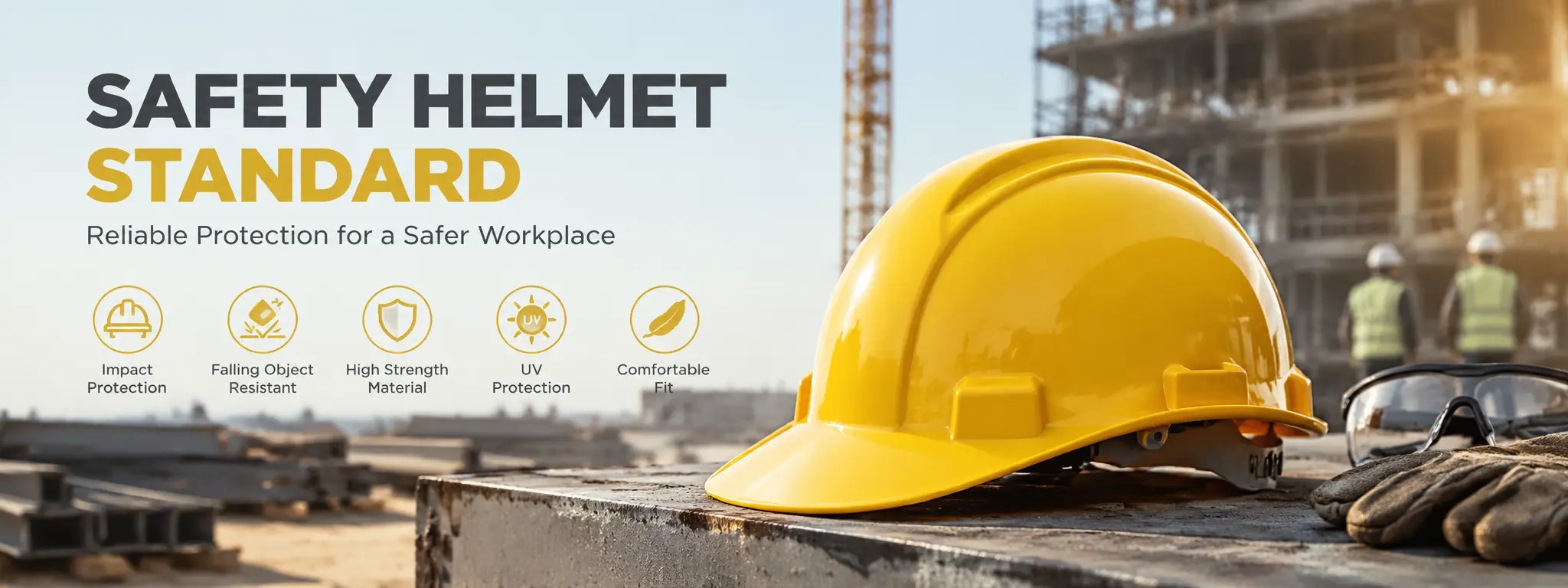
These situations happen in workplaces every day. A safety helmet may look like a simple piece of equipment, but the right helmet can play an important role in reducing the risk of head injuries.
This is why understanding the Safety Helmet Standard matters. A helmet’s color, shape, and appearance cannot tell you everything about its protective performance. Buyers need to understand how helmets are tested, what hazards they are designed to address, and which requirements apply to their industry and destination market.
For construction companies, industrial manufacturers, safety managers, and PPE distributors, the Safety Helmet Standard provides a practical starting point for choosing suitable head protection. It helps turn a general purchasing decision into a more informed evaluation of product performance, compliance documentation, comfort, and long-term usability.
In this guide, we explore seven essential Safety Helmet Standard facts, explain how they apply to everyday work, and share practical tips to help you choose the right protective helmet for your team.
| Product | Main feature | Key protection benefits | Suitable construction work |
|---|---|---|---|
| MK-W007 Welding Helmets | Welding helmet for general welding protection | Helps shield eyes and face from arc light, sparks, and radiation when appropriately rated | Steel structures, metal fabrication, pipeline welding |
| MK-W006 Welding Helmets | Welding helmet for construction metalwork | Helps protect against common welding hazards | Steel frame work, metal joints, equipment repairs |
| MK-W001 Darkening Welding Helmet | Auto-darkening filter (ADF) | Automatically adjusts lens shade and helps protect against welding radiation | Structural welding, repeated welding tasks, precision metalwork |
1. Why the Safety Helmet Standard Matters on Every Jobsite
Content Nav
A busy jobsite is full of moving parts. Workers may carry materials, operate machinery, climb ladders, pass beneath scaffolding, or work near colleagues using power tools. Even when everyone follows established safety procedures, unexpected incidents can still occur.
A suitable safety helmet is one part of a broader workplace protection plan. The Safety Helmet Standard helps establish measurable requirements for helmet design, testing, performance, and product identification.
Instead of relying on a manufacturer’s general description, buyers can use the relevant standard to understand what a helmet has been designed and evaluated to do.
Depending on the standard and helmet model, requirements may address:
- Impact absorption: Evaluates how the helmet manages specified impact forces.
- Penetration resistance: Assesses resistance to penetration under defined test conditions.
- Retention and fit: Evaluates the helmet’s ability to remain appropriately positioned during specified tests.
- Electrical performance: Applies to helmets designed and tested for relevant electrical hazards.
- Additional environmental performance: Certain standards include requirements for specific conditions or supplementary hazards.
- Product identification: Markings and instructions help users identify the helmet and understand its limitations.
For example, a construction company buying helmets for workers beneath overhead structures may prioritize impact protection and secure fit. An electrical maintenance contractor may also need to evaluate electrical classification and compatibility with other protective equipment.
Both buyers need to understand the Safety Helmet Standard, but their final product choices may differ because their workplace hazards are different.
The important lesson is simple: do not choose a helmet only because it looks strong or has a competitive price. Start by identifying the hazards workers face, then select a product whose documented performance matches those needs.
2. Know the Safety Helmet Standard Before Buying for Your Market
Safety helmet requirements can vary from one country to another. A helmet suitable for one market or project may not automatically satisfy the requirements of another.
For companies purchasing PPE internationally, the Safety Helmet Standard should be one of the first items on the procurement checklist.
Here are several important standards to understand.
| Standard | Main market or scope | What buyers should know |
|---|---|---|
| EN 397:2025 | Europe and markets using this standard | Covers industrial protective helmet requirements, performance, testing, and marking. |
| ANSI/ISEA Z89.1-2026 | United States | Addresses industrial head protection, including helmet types, impact performance, and electrical classifications. |
| ISO 3873:2025 | International standard | Specifies physical and performance requirements, test methods, and marking for industrial protective helmets. |
| CSA Z94.1 | Canada | Relevant to industrial protective headwear in the Canadian market. |
| AS/NZS 1801 | Australia and New Zealand | Covers occupational protective helmets under the applicable requirements. |
| GB 2811 | China | China’s national standard for safety helmets. |
EN 397:2025 is listed by the British Standards Institution as a current edition for industrial protective helmets. ANSI/ISEA Z89.1-2026 includes updated classifications and testing provisions, while ISO 3873:2025 provides requirements for industrial protective helmets at the international standards level.
The precise edition accepted for a particular purchase depends on the destination market, local regulations, conformity assessment requirements, and project specifications. Buyers should verify these details before placing an order.
What does this mean for PPE buyers?
Imagine that a construction company is preparing a project in Europe. Its procurement team finds a helmet advertised as suitable for industrial use. The product looks durable, and the supplier offers an attractive bulk price.
However, before ordering several hundred units, the team should check whether the helmet meets the standard and conformity requirements applicable to that project. It should also review the product’s technical documentation, markings, and intended use.
This extra step can prevent avoidable procurement problems and help ensure that workers receive appropriate protection.
For international buyers, understanding the Safety Helmet Standard also makes communication with suppliers easier. Rather than asking only for a “good-quality safety helmet,” buyers can specify the required standard, protection type, electrical performance, accessories, and documentation.
A clear specification is often the foundation of a more reliable purchasing process.
3. Choose the Right Helmet Type for Real Workplace Hazards
Not all head injuries happen in the same way. A falling object may strike the top of a worker’s head, while a collision with equipment may involve the side of the head. This difference is one reason helmet classification deserves careful attention.
The Safety Helmet Standard helps buyers understand the performance category of a helmet, but classifications must always be interpreted within the specific standard used.
Type I helmets: Focus on top-impact protection
In standards that use this classification, Type I helmets are designed primarily to address impacts to the top of the head.
They may be appropriate for certain construction, warehouse, manufacturing, and maintenance applications where overhead hazards are a major concern, provided the particular helmet meets the workplace’s requirements.
Consider a construction worker moving beneath scaffolding or a warehouse employee handling materials stored on elevated racks. In these situations, falling-object hazards may be an important part of the risk assessment.
The selected helmet should meet the applicable Safety Helmet Standard, fit securely, and be used alongside other controls that reduce the likelihood of objects falling.
Type II helmets: Consider additional impact directions
Under standards that define Type II helmets, protection extends to impacts involving the top and additional areas of the head, including lateral impacts.
This classification may be relevant in workplaces where workers could encounter impacts from multiple directions. However, the exact test requirements and protection claims depend on the standard and product certification.
For example, workers in some industrial facilities may operate around fixed machinery, structural supports, and confined work areas. A helmet designed and tested for additional impact directions may be worth considering when supported by the workplace risk assessment.
Why classification alone is not enough
Two helmets that look similar may have different classifications, test results, or intended applications. Buyers should not assume that all hard hats provide equivalent protection.
When evaluating the Safety Helmet Standard, check:
- Which standard the helmet claims to meet.
- Whether the product has the required type or classification.
- What hazards the helmet is designed to address.
- Whether the helmet’s accessories are compatible with its protective design.
- Whether the documentation supports the manufacturer’s claims.
A helmet is also not a substitute for a fall-protection system. Even a helmet designed for additional impact directions cannot guarantee prevention of serious injury during a fall.
The best choice is the helmet whose verified performance matches the actual hazards, rather than simply the product with the most impressive description.
4. Electrical Work Requires Extra Attention to the Safety Helmet Standard
Electrical workers often face more than one hazard at a time. A maintenance technician may need to protect against accidental head impacts while working near electrical equipment. A utility worker may need to consider electrical exposure, weather conditions, access equipment, and compatibility with other PPE.
In these environments, the Safety Helmet Standard becomes especially important because general impact protection and electrical protection are not the same thing.
Some standards define electrical classes or other requirements for helmets intended for particular electrical applications. For example, ANSI/ISEA Z89.1 includes electrical classifications.
Before purchasing helmets for electrical work, buyers should consider the following factors.
Electrical classification
Confirm that the helmet’s documented electrical performance matches the applicable workplace requirements. Never assume that a general-purpose industrial helmet provides electrical insulation simply because it has a plastic shell.
Workplace conditions
Identify the electrical hazards, the nature of the work, and the relevant safety procedures. A product appropriate for one task may not be suitable for a different electrical exposure.
Accessory compatibility
Face shields, hearing protection, headlamps, and other accessories can affect how equipment fits together. Check that the selected combination is suitable for the intended use.
Product documentation
Request the technical specifications and relevant test or conformity documents. These help confirm whether the product meets the required Safety Helmet Standard and any additional specifications.
Inspection and maintenance
Follow the manufacturer’s instructions for cleaning, storage, inspection, and replacement. A helmet that has been damaged, modified improperly, or used beyond its permitted service life may no longer provide the intended performance.
Electrical hazards demand careful selection. Buyers should evaluate the complete protective solution rather than treating the helmet as an isolated product.
5. Look Beyond Appearance: Check Safety Helmet Standard Markings and Documents
A new helmet may have a clean finish, a sturdy shell, and an attractive design. But those features do not independently prove compliance with a Safety Helmet Standard.
For purchasing teams, product markings and technical documentation are essential parts of the evaluation process.
What should buyers look for?
Manufacturer and model identification
Clear product identification helps buyers distinguish between models and trace the helmet to its documentation.
Applicable standard
Check the standard and edition claimed by the manufacturer, along with any required product markings.
Protection classification
Where applicable, verify the helmet type, electrical class, or other performance designation.
Instructions for use
Review information about correct adjustment, compatible accessories, cleaning, inspection, storage, and replacement.
Conformity and test documentation
Request the relevant declaration of conformity, certificate, or test report where applicable. Check that the documents relate to the exact model being purchased.
Traceability information
Depending on the applicable standard, markings may include manufacturing or other identification details that support product traceability.
A practical example for bulk buyers
Suppose a distributor plans to purchase 1,000 industrial helmets for several customers. One customer needs helmets for general construction, while another needs helmets for a facility with specific electrical safety requirements.
Ordering one model for every customer simply because it is available in large quantities could create unnecessary risks.
A better process is to define the required Safety Helmet Standard for each application, review the product documentation, and confirm whether the same model can legitimately satisfy both sets of requirements.
This approach helps prevent confusion between products that look alike but serve different purposes.
For MKsafety® customers, the same principle applies when comparing head-protection options: technical suitability and supporting documentation should come before assumptions based on appearance or price.
6. Comfort, Fit, and Durability Matter More Than Many Buyers Expect
Safety performance is essential, but a helmet also needs to work in real conditions. Construction workers may spend hours outdoors in the sun. Warehouse employees may repeatedly bend, lift, and turn their heads. Maintenance technicians may wear helmets alongside goggles, earmuffs, and face shields.
If a helmet is uncomfortable, poorly adjusted, or incompatible with other PPE, workers may be tempted to loosen it, reposition it incorrectly, or remove it when they should be wearing it.
This is why practical usability deserves attention alongside the Safety Helmet Standard.
Fit and adjustment
A helmet should sit correctly and remain secure during normal work. The suspension or adjustment system should be easy to use and should follow the manufacturer’s instructions.
A helmet that is too loose may shift during movement. One that is adjusted incorrectly may not provide the intended fit or performance.
Weight and balance
Helmet weight and balance can affect comfort during long shifts. Buyers should compare these characteristics while ensuring that the selected product still meets the required protection specifications.
Ventilation and working temperature
Ventilation can improve comfort in hot environments, but it should never be chosen at the expense of required protection. In particular, a ventilated design should not be assumed suitable for electrical work unless the product documentation confirms its suitability.
Compatibility with other PPE
Some workers need safety glasses, hearing protection, face shields, respirators, or headlamps. A compatible system allows these items to work together without creating unnecessary interference.
When evaluating the Safety Helmet Standard, buyers should also ask whether the helmet has been designed for the accessories required in the intended workplace.
Durability and replacement
Repeated exposure to sunlight, heat, chemicals, impact, or unsuitable storage conditions may affect helmet materials. The extent of these effects depends on the product and environment.
Workers should inspect their helmets according to the manufacturer’s guidance. Helmets should be removed from service when damaged or when required by inspection findings, an impact event, or service-life limits.
A reliable helmet program combines an appropriate Safety Helmet Standard with proper fitting, regular inspection, correct storage, and timely replacement.
7. Find a Reliable Supplier for Long-Term Head Protection
Choosing a safety helmet supplier is not just about finding a manufacturer with a large product catalog. For companies purchasing PPE in volume, the supplier should understand the required standards, provide accurate product information, and maintain clear communication throughout the purchasing process.
The Safety Helmet Standard provides a useful starting point for comparing suppliers because it encourages buyers to ask specific, verifiable questions.
Product compliance and documentation
Ask whether the supplier can provide the documents relevant to the exact helmet model and destination market. Confirm that the claimed standard, classification, and test evidence match the product being quoted.
Consistent product specifications
For repeat orders, clear specifications help purchasing teams compare batches and identify changes. Product details such as the shell design, suspension, accessories, markings, and packaging should be confirmed before production.
A suitable product range
Different customers may require different levels of protection. A supplier offering multiple helmet configurations can help buyers evaluate options for construction, warehousing, manufacturing, and other applications, provided each product’s suitability is supported by documentation.
Customization without compromising compliance
Some businesses prefer specific colors, logos, or packaging. These requirements should be discussed before production. Any customization must preserve required markings, traceability, and the helmet’s conformity with the applicable Safety Helmet Standard.
Bulk orders and delivery planning
Before placing a large order, confirm quantities, lead times, packaging details, inspection arrangements, and shipping requirements. Samples may also be useful for assessing fit, finish, and compatibility before committing to a larger purchase.
Communication and after-sales support
A reliable supplier should respond clearly to questions about specifications, product use, documents, and replacement parts. This is particularly important when buyers serve customers in multiple countries with different compliance requirements.
MKsafety® buyers can use these considerations to compare protective helmet options more effectively. Rather than focusing only on the initial unit price, evaluate whether the product and supplier can support the requirements of the intended application over time.
Safety Helmet Standard Checklist for Different Industries
The following table offers a practical starting point for evaluating head protection. The final selection should always be based on a workplace risk assessment and the requirements applicable to the destination market.
| Industry | Common hazards to assess | Safety helmet selection priorities |
|---|---|---|
| Construction | Falling objects, overhead work, impacts against structures | Applicable standard, impact performance, secure fit, accessory compatibility |
| Manufacturing | Machinery, moving materials, accidental impacts | Correct helmet classification, comfort, durability, inspection procedures |
| Warehousing and logistics | Stored goods, equipment, narrow aisles | Impact protection, fit, compatibility with other PPE |
| Electrical maintenance | Head impacts and potential electrical exposure | Required electrical classification, documentation, approved accessories |
| Mining and heavy industry | Falling material, confined areas, harsh working conditions | Relevant impact performance, durability, secure fit, task-specific accessories |
| Outdoor utilities | Weather exposure, work at height, electrical or mechanical hazards | Hazard-specific protection, retention where needed, environmental suitability |
A Safety Helmet Standard should never be selected based solely on the industry name. Two workers in the same industry may face very different hazards, so the final decision should reflect the actual work being performed.
MKsafety® Welding Helmets: Product Analysis for Construction Site Workers
Welding work is common on construction sites, particularly during steel structure installation, metal fabrication, pipeline construction, and equipment maintenance. Strong welding arcs, flying sparks, high temperatures, and ultraviolet (UV) and infrared (IR) radiation can expose workers to serious hazards. Choosing suitable welding helmets is therefore an important part of construction site safety.
Understanding the Safety Helmet Standard helps buyers evaluate protective equipment requirements. However, welding helmets primarily protect the eyes and face, so buyers should also verify the applicable welding eye and face protection standards rather than assuming that a general industrial safety helmet standard covers all welding hazards.
1. MKsafety® – MK-W007 Welding Helmets

Key Advantages and Performance
-
Welding arc protection: Helps shield the welder’s eyes and face from intense visible light and welding-related radiation when the helmet is appropriately rated for the task.
-
Spark and spatter protection: Helps protect the face from hot sparks and metal spatter generated during welding.
-
Support for safer working conditions: Provides a protective barrier between the welder and common welding hazards, helping workers carry out demanding metalwork more safely.
-
Practical jobsite application: Suitable for welding operations where reliable eye and face protection is essential.
Suitable construction site occupations
-
Structural steel welders
-
Steel frame installation workers who perform welding
-
Metal fabrication workers
-
Pipeline and metal pipe welding technicians
-
Construction equipment repair and maintenance welders
Safety Helmet Standard consideration: Before selecting the MK-W007, confirm its lens shade, UV/IR protection, impact resistance, and relevant product certifications. These details help buyers determine whether it is suitable for the specific welding process and workplace conditions.
2. MKsafety® – MK-W006 Welding Helmets

Key Advantages and Performance
-
Protection against welding hazards: Helps protect the eyes and face from welding arc light, sparks, and hot particles when used as intended.
-
Support for metalworking tasks: Suitable for construction activities involving steel components, metal joints, and welded assemblies.
-
Improved task-focused protection: Provides a dedicated protective barrier for workers performing welding rather than relying on ordinary safety glasses alone.
-
Versatile construction applications: Can be considered for welding work in building construction, metal workshops, and equipment maintenance, subject to its specifications.
Suitable construction site occupations
-
Building steelwork welders
-
Welding technicians working on metal frameworks
-
Metal structure fabrication workers
-
Construction machinery maintenance personnel
-
On-site repair and installation welders
Safety Helmet Standard consideration: Buyers should check whether the MK-W006 is designed for the intended welding method and whether its lens and helmet assembly meet the applicable requirements. Its precise performance should be confirmed from the manufacturer’s technical documentation.
3. MKsafety® – MK-W001 Darkening Welding Helmet

Key Advantages and Performance
-
Automatic lens adjustment: The auto-darkening filter (ADF) automatically changes the lens shade in response to the welding arc, helping the welder maintain eye protection during welding.
-
UV and IR protection: A properly specified ADF helps protect against harmful ultraviolet and infrared radiation.
-
Reduced risk of arc eye: Appropriate protection helps prevent painful UV-related eye injuries and reduce the risk of long-term eye damage.
-
Convenience during repeated welding: Automatic darkening can reduce the need to repeatedly lift and lower the helmet between welding tasks, depending on the model and working conditions.
-
Support for precision work: The auto-darkening function can help welders position components and begin welding with greater convenience.
Suitable construction site occupations
-
Structural steel welders
-
Steel fabrication and assembly welders
-
Pipeline welding technicians
-
Welding and repair technicians
-
Construction equipment maintenance welders
Safety Helmet Standard consideration: For the MK-W001, buyers should verify the ADF’s shade range, switching performance, sensitivity settings, power source, optical performance, and relevant eye and face protection certifications. These specifications are especially important when welding processes and arc intensity vary.
How to Choose Welding Helmets for Construction Sites
When purchasing welding helmets for construction teams, consider these essential factors:
-
Identify the welding process: Different processes and current levels may require different lens shades and protection characteristics.
-
Verify relevant standards: Check applicable welding eye and face protection standards, such as EN ISO 16321-2 or ANSI/ISEA Z87.1 where relevant to the destination market and product.
-
Check UV and IR protection: Confirm that the helmet and filter provide the protection specified for the intended task.
-
Consider comfort and visibility: Fit, weight, viewing area, and adjustability can affect comfort during long shifts.
-
Confirm compatibility with other PPE: Workers may also need respiratory protection, hearing protection, protective clothing, and suitable head protection.
-
Review documentation: Request technical specifications and applicable conformity documents before ordering in bulk.
The Safety Helmet Standard is an important consideration when evaluating head protection on construction sites, but welding helmets serve a more specialized purpose. Buyers should assess welding-specific eye and face protection requirements alongside any separate requirements for industrial safety helmets.
For MKsafety® customers, selecting the right welding helmet starts with matching verified product performance to the welding process, jobsite hazards, and local safety requirements.
Common Mistakes to Avoid When Choosing a Safety Helmet Standard
Even experienced purchasing teams can overlook important details when ordering head protection. Avoiding the following mistakes can make the selection process more reliable.
Mistake 1: Choosing only by price
A low unit price does not establish whether a helmet meets the required standard. Compare documented performance and suitability before comparing costs.
Mistake 2: Assuming all hard hats provide the same protection
Helmet types, electrical classifications, and additional performance claims can differ. Check the exact product specification.
Mistake 3: Treating every standard as interchangeable
EN, ANSI/ISEA, ISO, CSA, AS/NZS, and GB standards have different scopes and requirements. Confirm what the target market and project actually require.
Mistake 4: Ignoring accessories
A helmet may need to work with safety glasses, earmuffs, face shields, or other PPE. Confirm compatibility before ordering.
Mistake 5: Overlooking documentation
A product description is not a substitute for relevant test reports, conformity documents, or technical specifications.
Mistake 6: Forgetting inspection and replacement
Even a compliant helmet can become unsuitable if damaged, improperly modified, or used outside the manufacturer’s guidance.
Mistake 7: Failing to confirm the exact standard edition
A buyer may request a current standard while a project specifies a different accepted edition. Verify the applicable requirements before finalizing the order.
Keeping these points in mind helps buyers apply the Safety Helmet Standard more effectively and avoid common purchasing errors.
Frequently Asked Questions About Safety Helmet Standard
1. What is a Safety Helmet Standard?
A Safety Helmet Standard sets out requirements for the design, testing, performance, and marking of protective helmets. It helps employers and buyers evaluate whether a helmet is suitable for specific workplace hazards and applicable regulations.
2. Which Safety Helmet Standard is used in Europe?
EN 397 is a key standard for industrial protective helmets in Europe, and EN 397:2025 is a current edition. Buyers should still verify the conformity requirements and standard edition applicable to their specific market or project.
3. What is the difference between Type I and Type II safety helmets?
Under standards that use these classifications, Type I helmets focus primarily on top impacts, while Type II helmets address top and additional impact directions, including lateral impacts. The exact requirements depend on the specific standard.
4. Does a safety helmet that meets a standard protect against every workplace hazard?
No. A helmet’s performance is limited to the hazards and conditions covered by its design and applicable testing. Workers may also need eye protection, hearing protection, respiratory protection, fall-protection equipment, or other PPE.
5. Can I use the same safety helmet for construction and electrical work?
Not automatically. A helmet suitable for general construction may not meet the electrical requirements of a particular task. Check the applicable Safety Helmet Standard, electrical classification, product documentation, and workplace requirements before using the same model for both applications.
6. What documents should I request from a safety helmet supplier?
Depending on the market and product, buyers may need technical specifications, test reports, certificates, declarations of conformity, user instructions, and traceability information. Confirm that the documents correspond to the exact model being purchased.
7. How can MKsafety® help buyers choose suitable safety helmets?
Buyers can use the required standard, workplace hazards, helmet classification, fit, accessory needs, and documentation as the basis for comparing MKsafety® head-protection options. Before placing an order, confirm the compliance documents and product specifications for the selected model.
8. When should a safety helmet be replaced?
Follow the manufacturer’s instructions and workplace inspection procedures. Replace helmets when they are damaged, when an impact or other event requires removal from service, or when the stated service-life limit is reached. There is no single replacement interval suitable for every helmet.
Conclusion: Make the Safety Helmet Standard Part of Every Purchasing Decision
A safety helmet may be one of the most familiar pieces of workplace PPE, but selecting the right one requires more than choosing a color or comparing prices. The Safety Helmet Standard helps buyers evaluate protective performance, understand product classifications, and check whether a helmet is suitable for the intended application.
From construction sites and warehouses to manufacturing plants and electrical maintenance operations, the right choice begins with understanding the hazards workers face. Buyers should then confirm the applicable standard, review product markings and documentation, consider fit and accessory compatibility, and work with suppliers who can clearly explain their products.
For businesses sourcing head protection in bulk, these steps can make purchasing more consistent and reduce the risk of selecting unsuitable equipment.
Ultimately, the purpose of understanding the Safety Helmet Standard is straightforward: to make better-informed PPE decisions and help workers receive head protection suited to their real working conditions. With careful product evaluation, clear specifications, and proper helmet use and maintenance, organizations can build a more dependable approach to workplace safety.